
- July 11, 2026
- Xirons
- 0
What Age Should My Child Start Coding? A Parent’s Guide
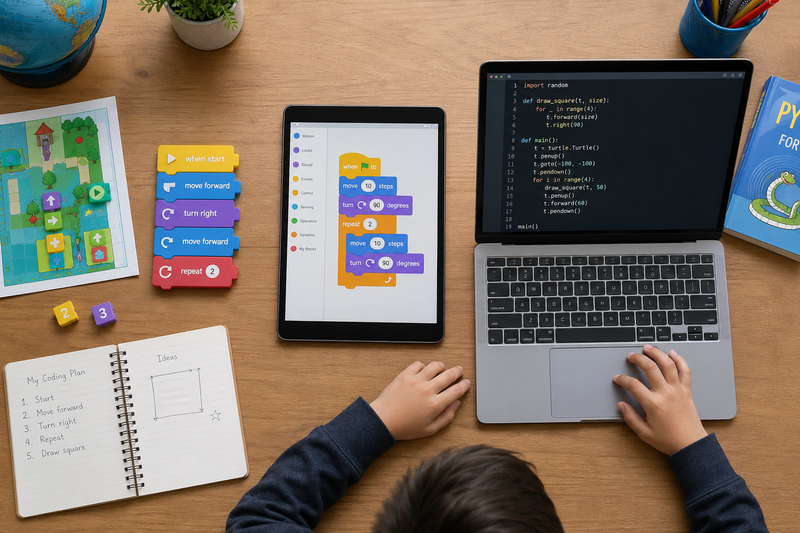
Most children are ready to start learning coding between ages 7 and 9 using visual, game-based platforms such as Scratch or Roblox Studio. Between ages 9 and 12, many children are ready to transition to text-based programming languages like Python. The best age to start depends less on your child’s birthday and more on their reading ability, attention span, confidence, and interest in technology.
If you’re wondering when your child should begin coding, here’s what parents should know.
Does Age Really Matter?
Age is a useful guideline, but it isn’t the only factor.
Children learn at different speeds, and the right starting point depends on their overall readiness rather than a specific birthday.
The three biggest factors are:
Reading and Typing Skills
Text-based coding requires children to read instructions, understand new concepts, and type accurately. A confident eight-year-old reader may be ready for Python sooner than a hesitant ten-year-old.
Attention Span
Coding involves solving problems step by step. Younger children usually learn best through shorter, interactive lessons that keep them engaged through games and creative projects.
Interest and Curiosity
Children who enjoy building games, exploring technology, or asking how things work often progress much faster because they’re naturally motivated to solve problems.
Coding Readiness by Age
|
Age |
Recommended Starting Point |
Main Focus |
|
7–8 years |
Scratch, Roblox Studio,Minecraft |
Learn logical thinking through games |
|
9–10 years |
Scratch + Introduction to Python |
Build confidence with real programming |
|
11–12 years |
Python, Web Development |
Create real-world projects |
|
13–16 years |
Python, AI, App Development |
Advanced programming and portfolios |
Remember, these are general guidelines. Every child progresses differently.
Ages 7–10: Build Strong Foundations
For most children, this is the ideal age to begin coding.
Visual programming environments such as Scratch and Roblox Studio teach computational thinking without requiring children to memorise programming syntax.
Instead of worrying about typing code correctly, children learn concepts such as:
- Sequences
- Loops
- Conditions
- Variables
- Problem solving
This allows them to focus on learning how programming works while having fun creating games and interactive projects.
Ages 9–12: Transition to Real Programming
As children become more confident readers and problem solvers, many are ready to start writing real code.
Python is often the first programming language because its syntax is relatively simple and easy to understand.
A child is usually ready when they:
- Feel comfortable using block-based coding
- Read instructions independently
- Can type confidently
- Want to understand how code works behind the scenes
The transition doesn’t happen on a specific birthday. It happens when the child is ready.
Ages 12–16: Build Real Projects
Teenagers can begin working with professional programming tools and larger projects.
This is typically the stage where students learn to build:
- Websites
- Python applications
- Games
- Artificial Intelligence projects
- Automation tools
These projects help develop practical programming skills while building confidence for future studies and careers.
What If My Child Is Older but Has Never Coded Before?
Starting later is completely normal.
A thirteen-year-old beginner doesn’t usually need to follow the exact same learning path as a seven-year-old.
Older beginners often understand logical concepts much faster and can progress through the foundations quickly before moving into Python or web development.
The goal isn’t to start at the youngest level, it’s to begin at the level that’s right for your child.
What If My Child Is Younger and Learns Quickly?
Some younger children move through beginner coding surprisingly fast.
If your child already understands block-based coding and wants to start writing real code, introducing simple Python projects can be a good next step.
It’s still important to balance this with fun, project-based learning so coding remains enjoyable rather than overwhelming.
Why Most Experts Recommend Starting with Visual Coding
Many educational researchers recommend introducing programming through visual coding before moving to text-based languages.
Visual coding helps children understand programming logic without becoming frustrated by typing mistakes or syntax errors.
Once those foundations are established, transitioning to Python becomes much smoother.
How to Choose the Right Starting Point
Rather than choosing a course based only on age, it’s better to look at your child’s current ability.
A good assessment should evaluate:
- Reading confidence
- Typing ability
- Logical thinking
- Problem-solving skills
- Interests (games, AI, websites, robotics, apps)
This provides a much more accurate recommendation than age alone.
At Xirons, every child begins with a free assessment session. Instead of placing students into a course based purely on age, we recommend a personalised learning pathway based on their current skills, confidence, and interests.
Key Takeaways
- Most children are ready to begin coding from around age 7.
- Visual coding is the best starting point for most beginners.
- Python is commonly introduced between ages 9 and 12.
- Reading ability and interest matter more than age alone.
- Every child progresses differently, so personalised assessments are often the best way to choose the right course.
Frequently Asked Questions
1 Can a 6-year-old learn coding?
Some children can explore simple coding concepts using beginner-friendly platforms such as ScratchJr or Minecraft Education. However, structured coding lessons are generally most effective from around age seven, when children can follow multi-step instructions more independently.
2 Is 10 too old to start coding?
Not at all.
Ten-year-old beginners often progress very quickly because they already have stronger reading and problem-solving skills than younger learners.
3 Should my child learn Scratch before Python?
For most children, yes.
Scratch helps children understand programming logic before they begin typing code, making the transition to Python much easier.
4 Can coding help at school?
Yes.
Coding develops logical thinking, creativity, problem-solving, and computational thinking. These skills support subjects such as mathematics, science, and GCSE Computer Science.
5 What age is suitable for AI classes?
Most AI programmes for children are best suited for ages 9–16, after they've developed basic programming skills, often through Python.